|
Nod to the North Sea
We pointed our minds and spirits to the North Sea, not the area of Brugge where the roots of my Grandma Claeys lie and which we've visited in the past, but north of there, toward Middleburg and Rotterdam in the Netherlands.
We drove on a long isthmus, in fact a manmade dam separating the North Sea from part of itself, where huge modern hydraulic windmills pump water from the lowland up into the high sea. Much of the Netherlands is below sea level.
It appears that the people continue to claim land from the sea in this part of the world. If the dams or dykes were ever fatally wounded, all hell would break loose as the sea reclaimed its territory.
We saw a few old fashioned Dutch windmills, some still working, but we saw hundreds more of those new fangled windmills that are so familiar in the USA for harnessing wind energy. Wind currents at the North Sea make these towering sleek giants exceptionally powerful and productive.
About 7 p.m. that evening we arrived in Delft, the city of that famous finely painted and detailed pottery, much of it blue and white. We searched and searched for room at the inn, which was no easy task since the city is not only like other Dutch towns with narrow cobblestone streets, it is also replete with canals and one-ways, not to mention roundabouts.
No Holiday Inns or Ibis Hotels lined this landscape. Finally, about 8 p.m. -- in the midst of the red-brick, street-lined, high-rise homes along the canals -- we glimpsed one single solitary small sign: "Hotel."
I ran in and asked the important ques-tion. The place was full, but we were given a small map of similar hideaway "hotels" in Delft. The next "hotel" we checked had a room for us. The place was wonderful and better than quaint.
It was, in fact, an old home of many rooms, owned by a middle-aged couple, the Da Vlamings, who must have had about a dozen of us come out of the woodwork for breakfast the next morning. Without intentional eavesdropping we heard many of them speaking the King's English.
After breakfast that Sunday morning we followed the sound of church bells, a difficult endeavor since three huge gothic churches had been constructed in Delft within three blocks of each other and we didn't know which way to turn in the hard wind and rain. Our umbrellas kept turn-ing inside out. Brrrr. We didn't complain too much about the day's biting weather.
None of the three churches appeared in good repair. The largest remained locked at all entrances on this Sabbath. But the one we found open was in the midst of a $600,000 renovation; scaff-olding filled the inside ceiling to floor and people filled the pews front to back, evidence again of the new springtime.
Except for tiny familiar parts in Latin, such as the Kyrie Eleison, the entire Mass was in Dutch. Much of the language has enough similarities to German and English for me to get the hang of it, however.
After Mass we stopped to watch artisans at work with their hand stenciling and intricate painting of the Delft pottery. Temptation led to purchase, but only in moderation.
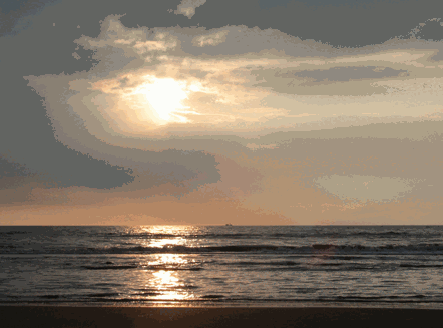
Traveling further north to the coastal city of Zandvoort, we chose a spot for the next three nights that gave us a perch on the fourth floor of the luxury NH Hotel. It is located directly on the sandy beach of the North Sea where we drank in the traditional strong coffee, deep blue sky, and white rolling waves each morning.
Huge ships loomed on the horizon, riding the skyline as though an artist had intentionally placed them on point. The sea and its sound are calming. Waves are rolling in, not rushing in, as though they wore themselves out on the journey. Is it the North Sea or is it the reflection of the setting sun that casts the spell?
One day we catch a train to Amster-dam, another day we drive to the Keuken-hoff, on the third day the sea is silent for the first time. Its edges gently ripple like an uneven hemline. Hotel flags remained furled as we drive even further north in this Dutch country to look for the Zuiderzee. I find myself singing old familiar tunes with haunting melodies.
Let us go to the banks of the ocean
Where the walls rise above the Zuiderzee.
We discovered there is no longer a Zuiderzee, that it became two or three freshwater bodies of water after the construction of dykes and the pumping of canals into it. The power of Dutch windmills to lift fresh water from the inland canals up into the dyked sea meant the demise of the Zuiderzee. It lost its saltiness, its largesse, its romance, and became the Ijsselmeer and Markermeer.
Click here to continue.
|
|