|
We learned that back in the old days, homes and villages on the Zuiderzee were flooded a couple times a year when winds would swell the waters into mounting un-stoppable waves. Constructing miles of dykes through the Zuiderzee reduced the threat of flooding.
The Dutchman's not the kind of man
Who keeps his thumb jammed in the dam.
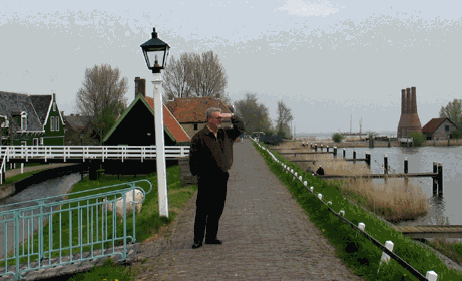
A tourist boat took us to visit an area of a Dutch village that is now the Zuiderzee Museum. Its remoteness and isolation from the rest of the world once lent itself to unusual ways and particular clothing such as the large winged hats and pointy wooden clogs.
On our amble through the preserved village, I spied a visiting Dutchman in obviously worn clogs and asked about their comfort. "Once you've worn them, you will always wear them," he said. "It's like walking on air. In the winter they're warm. In the summer they're cool."
The Dutchman still wears wooden shoes,
His cap and coat are patched with love.
'Twas a picturesque and captivating history lesson from this land that bears familiar names from my youth at every turn.
Amsterdam & Aalsmeer
Amsterdam is a city of huge canals, the first ones dug in the 13th century. We picked up a cruise boat and learned that Amsterdam used to have a severe housing shortage, hence the numerous houseboats lining some canals.
The city, named after the Amstel River and not the Amstel Beer, has a population today of 750,000. We were not surprised to learn that the number of bikes in the vicinity is 1.2 million, for we had already photographed an 8,000-bike parking ramp. There were bikes and bikers all over the place. I was reminded of my parents' stories about China.
In crossing a street, trying to avoid the trains and cars and pedestrians, I ran into a biker. He was not happy with me, but he also was not rude. I apologized.
We walked several blocks to the Anne Frank Huis at Prinsengracht 267 and toured the famous hideaway. Many Dutch people suffered under the Nazis.
From our junior class play at the Minneota High School back home, Allan and I knew that Anne Frank wanted to grow up to be a writer, a journalist. She never had the chance to grow up because she died in a concentration camp at Belgen Bersen at the age of 15, but she did become a famous writer because of the journals she left behind after her family's captivity.
I asked Allan to take a picture of me passing through the secret opening behind the bookcase, only to be told later that cameras are not allowed in this hallowed home. I wonder if I dare include that photo in my online version of this story.
Only a couple doors down from the secret hiding place of Anne and her family is the Westerkerk, one of the oldest churches especially built for Protestant services. We learned that it opened in 1631, and that Rembrandt, the famous painter, was buried in the church. Anne Frank wrote her diary in view of its tower and comments on the tolling of its bell.
About a half hour south of Amsterdam we found Bloemenveiling Aalsmeer, the location of the world's largest flower auction and we saw it all -- by accident!
It was still dark that morning when we pulled into a huge parking lot on top of the gigantic auction facility. We had heard by the grapevine that the auction starts at 6 a.m. and is finished in two to three hours, so if we wanted to see the action we had better get there on time.
Well, the doors were still locked at 6 a.m., and a sign on the door said it only opened at 7:30 for tourists. Not one to be detoured in the dark -- the sun had not yet risen -- I inquired of a young man carrying a briefcase just how we might get into the building. The nice man, an employee in the computer section, said, "Just follow me." We did.
And because there were only two of us, rather than a gaggle of noisy tourists, we walked right into the private auction rooms. Fascinating. It's all done by computers, yet the millions and billions of flowers show up in live bloom and living color for the buyers. Amazing. You can see some of it online in Sue's Album.
The Aalsmeer complex is spread out over an area roughly the size of 250 football fields. We learned that it all began about a hundred years ago, in a cafe much like with the Holy Family Catholic High School in Victoria, Minnesota! And, today, over 55,000 transactions take place each morning, allowing the flowers and plants to be transported to all corners of the globe within 24 hours.
Nowhere else in the world are so many flowers traded in one place. Most of the growers are Dutch. Acres of fields are red and blue and orange, not Minne-sota green and gold.
In 2002 over 1.75 million roses were sold, 600 million tulips, and 474 million chrysanthemums. Yes, more roses are grown and traded in Holland than tulips.
Click here to continue.
|
|