|
Every hour on the hour we heard the local church bell toll. In this tight village of 700 people, there is not a resident priest. The prominent gray stone church, which was in the midst of interior painting and renovation, shares a priest with other villages in the area. Renovation of several churches we encountered on this trip tells us there is, indeed, a new springtime underway.
"Get lost and find your way back," said Jessica when we asked how to best find sights and things to do in the area. And that's just what we did, several times over, finding both quaint and common nooks and crannies for wine and sand-wiches. A ham sandwich cost about 4 euros and a glass of wine about 2 euros
-- for a total of about $10.
The closest city to our village was Dinant, which grew up eons ago in gorgeous country along the winding Meuse River. We climbed on foot for a long distance to get a bird's eye view and photo of the city. It was worth it.
One evening in Dinant we savored a pot of moules ardennaises at Leon's, a restaurant owned by six generations of the Vanlancker family since 1893. History in this territory takes on a whole new mean-ing. Our Dutch treat here could be des-cribed more clearly as mussels with bacon and mushrooms in a sauce of cream and white wine.
One night we had a topsy-turvy vegetable dish -- white asparagus with a green Hollandaise sauce! We learned that white asparagus is a European favorite. The secret to creating it is covering the stalks with dirt as they grow. The lack of exposure to sunlight keeps them from turning green. My goodness, what will they think of next.
Our favorite appetizer: Carpaccio de boeuf, petite salade de roquette et copeaux de parmesan. Yes, only French is spoken in this southern part of Belgium, and both residents and merchants informed us with a wave of the hand or shake of the head that they didn't speak a word of English. Said Jessica when we relayed our experiences, "They can be ratty." (And it's pronounced "rahty.")
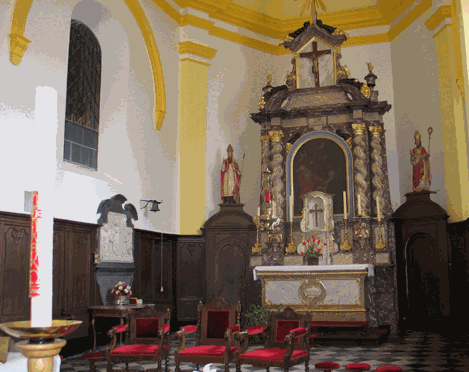
We also visited the church in Dinant. Stepping inside, at least for a moment, seems not only an opportunity but a requirement, for a splendid church building is the dominant structure by far in each city and village we've ever seen in our European travels. I thought of the missionaries long ago who struggled to bring the faith to others and the peasants who sacrificed to live it. Their place in history should not be slighted; their place in the future should not be underestimat-ed.
One day we drove about an hour up to Brussels for a change of pace, which is exactly what we got. The Grand Plaza is very grand, ornate, with much more red stone than gray stone. Treated to another day of blue sky and sunshine, we stood in awe in the center of this grand place and soaked in as much as possible.
Not being history buffs, we can't fill in the details very well, but Allan is respectful of the major engineering and architectural feats of centuries ago, when people were not so primitive as we think. And I try to be respectful of any work done in love and truth for a lasting purpose outside of oneself. In any case, travel is a good teacher.
We followed a seemingly insignifi-cant street from the Grand Plaza to a wee little fellow in the corner on an intersec-tion where he was doing a wee-wee little thing. Of course we've heard before of the Manneken Pis, a legendary Brussels figure and hero. If you want the whole story of this naked bronze boy, check my online pictures and captions in Sue's Album.
In Brussels we immediately noticed that many of the people speak Dutch and always respond to us in English, some more proficient than others. Sun-warmed faces and dispositions seemed every-where.
We learned from Jessica that Brussels marks a sort of dividing line in Belgium, with the southern French-speaking people not only refusing to learn English but also Dutch, which is known commonly as Flemish. And since politicians in Belgium are required to speak the "first language" of Dutch, the politicians are usually the Flemish, a term that can refer to the people as well as the language in the northern Flanders area.
By the way, nobody speaks Belgian. There isn't such a language!
Click here to continue.
|
|