|
Says Candy, the Director of Kid Talk, "Tom doesn't know about speech therapy and I don't know about accounting. It works out well for us."
In addition to her education, includ-ing a Master's Degree in Communication Disorders from the University of Minnesota in 1995, Candy had experience before Kid Talk. She worked at Hillcrest in Wayzata, a nursing home where she provided speech therapy to seniors who were recovering from the effects of a stroke, for example
She also had experience at another pediatric clinic in the area for a while where she learned that she especially enjoyed working with children. Upon receiving a call from Ridgeview Medical Center in Waconia, Candy started a pediatric speech and therapy program for the hospital and worked there for several months before striking off on her own in 2001.
Initially, Candy was the sole therapist at Kid Talk and she officed in small quarters for a couple months in the Cabin Fever complex in Victoria. In July of 2001 she moved her clinic to Main Street Victoria, "next to the Post Office," and stayed in that location until those quarters could no longer contain the growing staff and number of children requiring the services of Kid Talk.
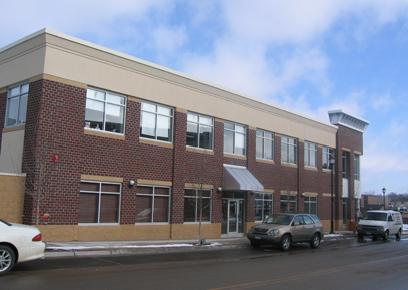
Together, in 2004, Tom and Candy Almquist made a decision to construct a new office building in downtown Victoria. They purchased the former Braunworth Hardware/Sidco 4x4 property from the City of Victoria, hired KKE Architects to design the building and Shaw Construction to build it.
On May 2nd, 2005, Kid Talk moved to the spacious quarters with large windows and beautiful views. There are currently ten therapists, including Candy, working at the clinic. Five of the therapists are Victoria residents. The children come from within an hour radius of Victoria. Most are residents of Carver County.
One would not suspect this amount of activity to be occurring in downtown Victoria. It is not evident. Traffic and parking are not huge issues because parents .. and cars … come and go with their children.
What kind of therapy does Kid Talk provide? Energy and passion return to Candy's voice.
"We work with so many different children with different issues," she said. "We work with sensory integration, for example."
Candy reaches for the phone and asks Kim Dieken, one of her occupational therapists who is a Victoria resident, to come to the office and elaborate about sensory integration.
Kim explains that information must get to the brain; it must be received, organized, and interpreted. "We work to balance all of the systems," said Kim. "We work to balance a child's senses. Some children can't handle all of the information coming to them at one time and will get hung up on one thing."
Kim explained that's why some children will rock and rock or will bang their head continuously. They get hung up on one sensory activity.
Various textures of food can also be an issue, she said. Some children can't handle some textures, but we can help them overcome that issue through feeding therapy.
Candy explained that children also receive occupational therapy for handwrit-ing, dressing, grooming, and fine motor sensory skills.
She commented that some infants also have feeding difficulties because they, literally, can't suck. For example, an infant with Downs Syndrome may be too weak to suck out of a bottle. "It is our job to teach the mother techniques that will increase the infant's strength to suck," said Candy. "This involves various exercises and changes of position."
Candy spoke of the "common phonological and articulation disorders" that result when children do not produce sounds correctly, like the "s" and "k" sounds. "It is important that parents ensure their child does not have recurring ear infections," she stated, "as this can affect acquisition of speech and language skills."
"Some children have a speech disorder called verbal apraxia," said Candy. "This is when a child has difficulty producing the movement necessary for speech. Many of these children are nonverbal, and it can take two to three years of therapy to get some of these kids to speak in full sentences."
Candy pointed to the educational and social implications for children with delayed skills. "Research has found that one of the best predictors in kindergarten of how well a child will learn to read is their ability to identify the sounds of letters," she said. "We use the term phoneme awareness. If a child's speech is delayed, chances are so is their phoneme awareness."
Click here to continue story.
|
|